Wycombe Hospital consultation meetings

Steve Baker outside Wycombe Hospital

Outside Wycombe Hospital

A crucial public consultation on the future of Wycombe Hospital began on 16 January. It is being run by Buckinghamshire Healthcare NHS Trust, which runs Wycombe Hospital. This is our chance to have our say on proposals to change how NHS services are provided in High Wycombe.

The exercise runs until 16 April and there are consultation meetings scheduled throughout the area every week in February. I urge everyone who cares about the future of our hospital to take part.

Click here for an explanation of the proposed changes and the schedule of public consultation meetings you can attend.

Ever since I was first selected  as the Conservative candidate for Wycombe, I have been working hard with local supporters of Wycombe Hospital. We are all keen to see services in the hands of the community and removed from further creeping centralisation and losses of service provision. So I welcome the Government’s intent in these current health reforms, which aim to move all NHS Trusts to NHS Foundation Trust status by April 2014 and to pass responsibility for purchasing patient care from Primary Care Trusts to the newly formed GP consortia a year before that.

This is a continuation of Labour Policy under the Blair government. NHS Foundation Trusts were introduced by Labour in the 2003 Health and Social Care Act as legally independent public benefit corporations. They are: 

  • Authorised and regulated by an independent regulator, known as Monitor;
  • Accountable to their local communities through a system of local ownership with members and elected governors – the governors being elected by the members;
  • Not required to break even each year although they must be financially viable. They can borrow money within limits set by the regulator, retain surpluses and decide on service development for their local populations;
  • Free from central government control and strategic health authority performance management; and
  • Required to lay their annual reports and accounts before Parliament each year.

There was a move to switch to Foundation status in Bucks during 2008 that was unsuccessful due to financial constraints. This initiative will be revived and a new submission is to be made in September 2012. I would encourage members of the public to support this move to Foundation status so that local people, as members and governors, can have much more direct control over Buckinghamshire hospitals.

My concerns are that Foundation Trusts may become too large and controlled from remote centres. That would be the opposite of both the Government’s vision and my own of a devolved and cooperative local arrangement. We need to avoid the bureaucracy and lack of accountability which has plagued the NHS locally for so long.

In the meantime, I again urge everyone interested in future of health provision in Wycombe to join in the consultation process. NHS consultations are currently how local voices are heard and I think it vital that hundreds of local people take part.

Buckinghamshire Community Foundation Winter Fuel Payment initiative

Over the Christmas period, the Buckinghamshire Community Foundation restarted their annual Winter Fuel Payment initiative, through which better off pensioners can donate those payments to people in need. Their initiative has raised nearly £14,000, which is nearly twice as much as last year. I am delighted that the people of Bucks have made this possible.

Amongst other initiatives, the Foundation is looking at new funding schemes with local businesses, such as the Midcounties Co-operative, and they are also working with local projects in various places across the county.

More details and opportunities to help will be announced at the Buckinghamshire Funding Fair at the Clare Foundation on February 16th.

DFID – Global Poverty Action Fund

The Government’s aid policy is controversial but those local charities and charitable institutions who seek to help those in need overseas may wish to take advantage of DFID’s  Global Poverty Action Fund:

The Global Poverty Action Fund (GPAF) was launched on 27 October 2010. It is a demand-led fund supporting projects focused on poverty reduction and pursuit of the MDGs through tangible changes to poor people’s lives including through: service delivery, empowerment and accountability and work on conflict, security and justice. Projects will be selected on the basis of demonstrable impact on poverty, clarity of outputs and outcomes, and value for money.

Read more: DFID – Global Poverty Action Fund.

As I have indicated before Entrepreneurship and opportunity are the primary keys to prosperity. I hope projects will recognise that business is development and direct themselves to that end but of course there are many immediate needs for the relief of abject poverty.

Wycombe Youth Action awarded £93,000

I am delighted that Wycombe Youth Action was successful in its application to the Transition Fund, which acts as a Big Society funding mechanism. The project received £93,000 to help young people from the ages of 13 to 25 in more positive activities that they may not otherwise have the opportunity to do.

The Transition Fund was announced last year as part of the Spending Review. So far it has committed £17 million for 201 charities; however there is £90million still available which will be announced from April 2011 onwards.

I would urge other civil society organisations in Wycombe who need additional funding to visit the website www.fundingcentral.org.uk for further information.

As Paul Burstow, Care Services Minister, has said:

Central Government can’t do everything people want in their communities – local people are better placed than officials or Ministers in Whitehall to know what their communities need. This is about a new relationship between the state and citizens, where citizens hold more power than ever before.

The Government is also setting up a Big Society Bank which will provide capital for the voluntary sector.

These are just the first steps to rekindle that mutual co-operation between individuals which typified British society. After the continued encroachment of the State over the past 100 years, we have seen a steady erosion of civil society. This is why we must reclaim local provisions and decision making.  In the long term, we need to de-politicise charitable funding but, in the meantime, the Government is seeking to drive a transition towards social responsibility, not state control. We should make the most of it.

I congratulate Wycombe Youth Action on their achievements and I wish them well with their extra funding.

The astonishing RAF Benevolent Fund

The Heart of the RAF FamilyBack in November, I mentioned the Royal Air Force Benevolent Fund in debate and I recently had the pleasure of meeting Paul Hewson, the Fund’s Regional Director for London, Home Counties and South England.

As it says on the Fund’s site:

We are the RAF’s leading welfare charity providing practical, financial and – in some cases – emotional support to all members of the RAF family, from childhood through to old age. We help with issues from childcare and relationship difficulties to injury and disability, and from financial hardship and debt to illness and bereavement.

The Benevolent Fund is a fantastic organisation, funded entirely by voluntary donations, including from serving people, who often give half a day’s pay a year to help their fellows. It’s a great testament to the spirit of the Royal Air Force that the Fund is able to provide a wide range of help to the entire RAF family without calling on taxpayer support.

There’s the Big Society in action: people choosing freely to provide for one another. It’s not a concept which belongs to any particular political party or group. It is simply community at its best.

Makes me proud to have served.

The Big Society: Social Power over State Power

Via Cameron relaunches Big Society ‘with moral purpose’:

The Big Society, which embraces hundreds of programmes which attempt to return power from the state to the people, has come under fire from some Tory MPs and activists, who claim it is virtually meaningless to voters.

It has also met Opposition criticism, including claims that it is merely an attempt to hand state-financed services to the private sector and a cynical “cover” for spending cuts.

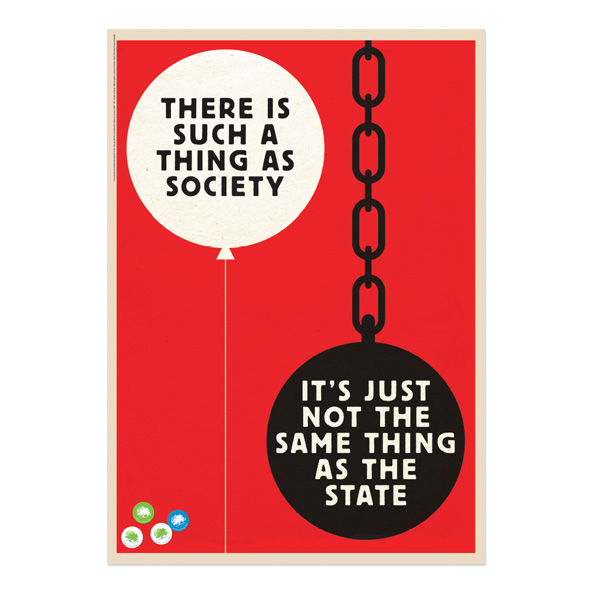
Isn’t it tragic that we have become so dependent on the state that the notion of building up bonds of voluntary relationship is now a mystery? The cynicism of the Opposition is very much to be regretted: I suppose it is reflective of the dominance of the statist Fabians in the Labour Party over the gentler mutualists.

I ran a series of Big Society quotes recently. My favourite is undoubtedly from Nock’s classic Our Enemy, The State:

It is unfortunately none too well understood that, just as the State has no money of its own, so it has no power of its own. All the power it has is what society gives it, plus what it confiscates from time to time on one pretext or another; there is no other source from which State power can be drawn. Therefore every assumption of State power, whether by gift or seizure, leaves society with so much less power; there is never, nor can there be, any strengthening of State power without a corresponding and roughly equivalent depletion of social power.

We have had a century of increasing state power, illustrated in the chart below. It now seems social power is so depleted that we scarcely realise the extent to which our lives have come to be dominated by the instrument of coercion and compulsion which is the state.

As I wrote previously on ConservativeHome:

The change we need is a change within. From a belief that human relationships should be based on class conflict and mutual plunder mediated by the State, to a reliance on mutual cooperation. From the view that business is somehow bad, to the realisation that all enterprise is social. From condemnation of profit, to an understanding that it is a measure of the value created for others. From fear of bearing risk, to the truth, that the search to create value for other people is the foundation of worthwhile community. From waiting for the State to decide and provide, to energetic, innovative mutual support.

Jesse Norman MP’s book The Big Society shows that the idea has a rich intellectual heritage and that it offers a positive alternative to a failed century of power transfer from society to the state.

I am glad David Cameron is relaunching the Big Society with moral purpose. One way or another, we all need the idea to succeed.

The Big Society is a threat to Labour | The Spectator

If you think there really is a big idea behind the Big Society, then you agree with the unlikely pairing of Jon Cruddas (Lab, Dagenham) and Jesse Norman (Con, Hereford). The latter’s new book, The Big Society: The Anatomy of the New Politics, attempts the seemingly impossible task of providing a grand philosophical narrative to underscore David Cameron’s often amorphous rhetoric.

via The Big Society is a threat to Labour | The Spectator. See also my Surely the Big Society is about more than volunteering?

I believe we are entering a period of “both/and” in society: we are both individuals and in society…

Big Society quote of the day – Postrel

Conserving only the underlying stable rules, while letting individual decision making drive change, is a concept that a century of technocracy has made foreign to most people. It does not fit neatly into the comfortable old left-right dichotomy and does not line up with technocratic assumptions about the powers and uses of government. It has a hard time making its case, because it promises only general patterns of improvement — spontaneous order and discovery — not specific results.

– Postrel, The Future and Its Enemies

Big Society quote of the day – Nock

It is unfortunately none too well understood that, just as the State has no money of its own, so it has no power of its own. All the power it has is what society gives it, plus what it confiscates from time to time on one pretext or another; there is no other source from which State power can be drawn. Therefore every assumption of State power, whether by gift or seizure, leaves society with so much less power; there is never, nor can there be, any strengthening of State power without a corresponding and roughly equivalent depletion of social power.

— Nock, Our Enemy, The State

Big Society quote of the day – Mises

But while the humanitarians indulged in depicting the blessings of this [classical] liberal utopia, they did not realize that new ideologies were on the way to supplant liberalism and to shape a new order arousing antagonisms for which no peaceful solution could be found. They did not see it because they viewed these new mentalities and policies as the continuation and fulfillment of the essential tenets of liberalism. Antiliberalism captured the popular mind disguised as true and genuine liberalism. Today those styling themselves liberals are supporting programs entirely opposed to the tenets and doctrines of the old liberalism. They disparage private ownership of the means of production and the market economy, and are enthusiastic friends of totalitarian methods of economic management. They are striving for government omnipotence, and hail every measure giving more power to officialdom and government agencies. They condemn as a reactionary and an economic royalist whoever does not share their predilection for regimentation.

– Mises, Omnipotent Government

Meanwhile, I am working throught the CSR document.