Remembrance Day

Let us give thanks for those who, in the day of decision, ventured their all for the liberty that we now enjoy.

May we strive to maintain freedom in our nation, in Europe and in the world, and to safeguard the peace which was won at such cost.

Today, I will be joining the Mayor of High Wycombe, Cllr Chaudhary Allah Ditta, at the Remembrance Day parade and service at All Saints, where I will lead prayers. In the evening, I will be joining a Bible study.

On 11 November, I joined teachers and pupils from Crown House School in a remembrance ceremony at the war memorial on the Rye.

The EU should be abolished

Via Calls for a referendum on EU membership after David Cameron’s U-turn on tax | World news | The Observer:

Tory and Labour MPs believe that if the eurozone moves towards a single tax system – as chancellor George Osborne advocated again – then the EU will become a fundamentally different organisation to the one the UK joined in 1973. Many also fear that Britain will come under intense pressure to adapt its tax and regulatory policies to conform more closely with the eurozone once fiscal union is under way, even if the UK remains out of the single currency.

Steve Baker, the Tory MP for Wycombe and a member of the fiercely eurosceptic 2010 Conservative intake, said: “It is very clear that the EU is heading at full speed towards being one country. As that is the case there is absolutely no doubt that the British people should be offered a vote on whether to be a part of that.”

I see no reason why fiscal planning at the EU level should be any more successful or acceptable to the European people than the arrangements which have failed. It would be better to abandon the Euro in favour of new monetary arrangements — such as competing currencies, proposed by the Treasury in November 1989 — and abolish the EU in favour of ultra-minimal arrangements under the Council of Europe to guarantee free trade and peace.

In the meantime, my People’s Pledge page is here.

Sri Lanka update

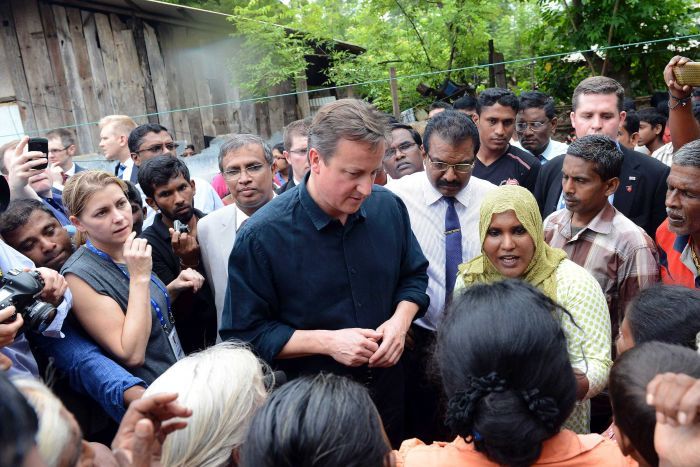
A number of my constituents have contacted me about the situation in Sri Lanka and the allegations of war crimes.

I wrote to Alistair Burt, Parliamentary Under-Secretary of State for the Foreign and Commonwealth Office, seeking more information. He recently replied as follows:

The UK wants to see lasting peace and security in Sri Lanka. We have encouraged the Government of Sri Lanka to involve all communities in a fully inclusive process which addresses the underlying causes of the conflict.

On 25th April the UN Panel of Experts published its report on accountability for alleged violations of international human rights and humanitarian law during the military conflict which ended in May 2009. We are studying the report carefully, but the serious allegations made in it make it clear that the issue of accountability must be resolved before lasting reconciliation can be achieved in Sir Lanka.

We have consistently called for an independent and credible investigation to address these allegations which is why we fully support the decision of the Secretary-General to establish the Panel of Experts. We encourage Sri Lanka to use its response to the UN report and the report’s recommendations to strengthen the process of accountability.

I await the Government’s extended views when Sri Lanka replies to the UN report. In the meantime, here is the full report.

A campaign for one day of peace or how I met Jude Law

Steve with Peace One Day Ambassador Jude Law

Via my article A campaign for one day of peace » The Cobden Centre:

As Member of Parliament for Wycombe, I am acutely aware of the widespread consequences of armed conflict on individuals across the world. For example, many of my constituents hail from Kashmir and Pakistan and their extended families and friends continue to be directly affected by the conflicts in the region and their fallout. Many are of Sri Lankan descent and have lived through conflict there, often having lost loved ones.

The tragedies of violence around the world come home to my constituents day after day. For anyone serious about promoting human flourishing, peace must be a prerequisite and the initiation of violence anathema.

It was an incredible privilege to meet Peace One Day founder and Chairman Jeremy Gilley, as well as their Ambassador, Jude Law.

As I left, I found a small crowd of young women giggling excitedly by the door, too nervous to speak to Jude. It wouldn’t happen to an MP!

Tony Blair and the Kellogg-Briand Pact

Via The Telegraph:

Tony Blair sidelined the Cabinet over the decision to invade Iraq because he feared ministers would leak sensitive material to the press, the head of the civil service has said.

For the moment, this speaks for itself and to the nature of the Blair government, but I’m looking forward to the eventual report of the Iraq Inquiry.

In the meantime, you may wish to read the brief treaty which is the Kellogg-Briand Pact of 1928. It provided for the renunciation of war as an instrument of national policy. Obviously, it failed, but Great Britain was a signatory and I understand it is still in force.

Is it teatime?

Tuesday will see the USA hold midterm elections. According to The Telegraph:

Tea Party candidates are poised to storm Washington in the midterm elections, when the conservative movement should win enough seats to form a powerful minority able to push its political agenda.

The key elements of the Tea Party programme are, we are told, balanced budgets, smaller government and free markets. According to one US citizen I spoke to over the weekend, a typical Tea Party meeting comprises ordinary men and women who have simply had enough of their government over-promising, over-taxing and failing to deliver.

A quick glance across the internet suggests people are surprised by the speed with which the movement has grown. Not me. Anyone who has been following Ron Paul and the Campaign for Liberty will know this movement has been growing for years.

Is it teatime? I hope so, but in the meantime, here’s a contribution from the Campaign towards fighting evil this Halloween:

The hopeful path between denial and despair is the reinvention of Britain

Via BT ruling could open pension claim floodgates – Telegraph:

Taxpayers could be on the hook for tens of billions of pounds to cover a string of privatised companies’ pension schemes after the precedent set by BT’s landmark “crown guarantee” victory.

What next, I wonder?

Between the Institute of Economic Affairs, the Adam Smith Institute, The TaxPayers’ Alliance and The Cobden Centre, it is pretty clear that the British State owes trillions of pounds.

Yes, trillions of pounds. Somewhere between £4,800,000,000,000 and £7,900,000,000,000. That is, up to about £300,000 for every household in Britain.

Much of this comprises unfunded pension liabilities, so default or inflation would be particularly wicked.

Worse, even funded pension schemes hold government debt, meaning that private pension schemes also rely on the State.  Vast swathes of the population are relying on someone else being taxed later.

The idea that the State can underwrite BT’s pension scheme is a denial of the facts. And yet, as Disraeli wrote, “Despair is the conclusion of fools.”

If we are to find a hopeful path between denial and despair, then, sooner or later, we must reinvent this country. We must stop lending to the State and start saving by investing in productive activity. Everyone who can is going to have to seek to live at their own expense. The State will have to get out of the way and let the entrepreneurs – and that is all of us – turn our fortunes around by searching creatively for opportunities to produce value for others.

The keys are these:

  • Peace – a consistent doctrine of non-aggression.
  • The family as the basic building block of society, not the State.
  • Equality before the law, not after it.
  • Freedom from arbitrary government – the classical Rule of Law.
  • Property – the unity of ownership and control.

No doubt we must rediscover virtue too, but the law cannot deliver that.

A forthcoming Channel 4 documentary will explain our situation and make the case for the reinvention of Britain. I contributed a substantial interview, although I do not know the extent to which it will be used. Its working title is Britain: The Horror Movie. It will be transmitted sometime this Autumn

In the meantime, I recommend Bastiat, who wrote:

The state is the great fiction by which everyone seeks to live at the expense of everyone else.

How to transform a nation in ten steps

Brought forward. I was challenged last night to advocate flat taxes. Here’s one of my previous posts which does so. Another is here (you will have to forgive the oversize graphs).

The Georgian recipe for “an amazing transformation”:

  • Low and flat taxes
  • Legislative commitment to reducing the government’s fiscal footprint (IE spend less!)
  • Deregulation and cutting red tape
  • And thereby suppressing corruption
  • Unilateral free trade: no import tariffs or barriers of any kind
  • Very flexible labour legislation
  • No sector or industrial policy of any kind
  • No subsidies, no preferences, no exemptions – no market-distorting practices
  • No currency and capital controls
  • Sound monetary policy with hawkish anti-inflationary stance

See also: Tory conference: Georgia’s Prime Minister makes surprise appearance.

Hat tip to Dr Tim Evans

On self-ownership – whose property are you?

In response to my remarks on the illegitimacy of banning particular items of clothing, I have been criticised for asserting the concept of self-ownership: the idea that each of us has an inviolable property right in our own person. It turns out this is a difficult concept:

Property is the most fundamental and complex of social facts, and the most important of human interests; it is, therefore, the hardest to understand, the most delicate to meddle with, and the easiest to dogmatize about.

– William Graham Sumner, quoted in Boundaries of Order.

However:

The conflicts, disorder, and destructiveness that are so expressive of modern society arise from our confusion over the nature of property as a system of social order. So insensitive have we become to the role of property as the most important civilizing influence in our world, that we have even learned to regard the infliction of our wills upon the lives and property of others as expressions of “socially responsible” conduct.

Boundaries of Order, Butler Shaffer, 2009.

Questions relating to society are rarely considered in terms of property, and yet it is the most fundamental of social facts. What is property, how is it to be controlled and by whom? What does “ownership” mean? These are some of the questions which Butler Shaffer sets out to answer in Boundaries of Order – Private Property as a Social System.

Shaffer shows that control is the defining factor in the ownership of property. Liberty is not an abstract philosophical principle, but a way of describing the autonomous nature of life in its myriad forms. Liberty and spontaneity express the essence of living systems. Shaffer’s book is about how and by whom authority is to be exercised over individual lives. He demonstrates that whether or not we choose to claim self-ownership goes to the heart of what it means to be a free person and that liberty and self-ownership are synonymous: “We are free only insofar as we insist upon the exclusive authority to direct our own energies and other resources.”

I shall leave the subject here. If you wish to explore the concept of self-ownership and property as the basis of a peaceful, cooperative society, then I recommend Shaffer, which may be bought or downloaded here.

In the meantime, in the words of Number 6:

I will not be pushed, filed, stamped, indexed, briefed, debriefed or numbered. My life is my own.

OpenEurope

I met today with the excellent think tank OpenEurope, along with other MPs of various parties:

Open Europe is an independent think tank, with offices in London and Brussels, set up by some of the UK’s leading business people to contribute bold new thinking to the debate about the direction of the EU.

While we are committed to European co-operation, Open Europe believes that the EU has reached a critical moment in its development. ‘Ever closer union’, espoused by Jean Monnet and propelled forwards by successive generations of political and bureaucratic elites, has failed.

The EU’s over-loaded institutions, held in low regard by Europe’s citizens, are ill-equipped to adapt to the pressing challenges of weak economic growth, rising global competition, insecurity and a looming demographic crisis.

Open Europe believes that the EU must now embrace radical reform based on economic liberalisation, a looser and more flexible structure, and greater transparency and accountability if it is to overcome these challenges, and succeed in the twenty first century.

The best way forward for the EU is an urgent programme of radical change driven by a consensus between member states. In pursuit of this consensus, Open Europe will seek to involve like-minded individuals, political parties and organisations across Europe in our thinking and activities, and disseminate our ideas widely across the EU and the rest of the world.

It was all very encouraging. Through The Cobden Centre, I advocate free trade and peace in addition to our work on honest money, so naturally I am keen to promote a more open and dynamic Europe which is actually accountable to  the people, instead of trampling their democratic rights whilst issuing ever more regulations, raising nationalism to the continental level.

Apparently the EU is now ripe for radical reform. Good.