Autumn Statement chart of the day: living beyond our means for years

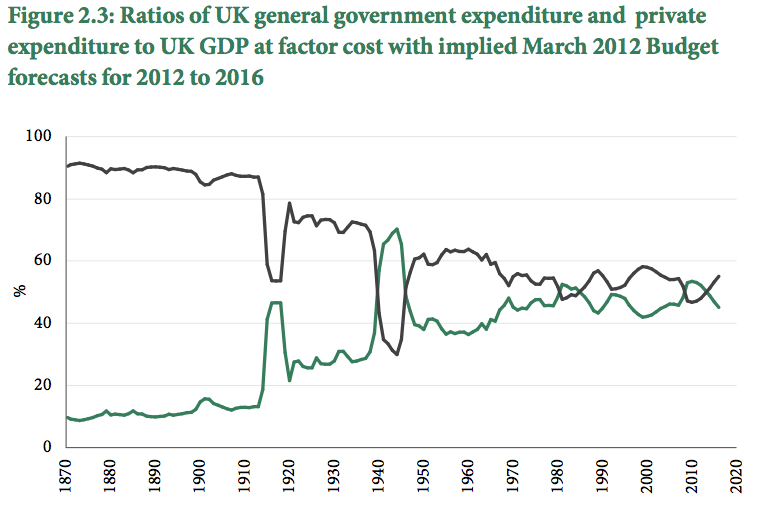
Via the Autumn Statement, page 25, forecast Government receipts and expenditure through the Parliament as a percentage of GDP:

Click for PDF

See also this chart, showing how our national debt is forecast to increase as a consequence. 

The legacy this Government was handed remains a scandal.

Autumn statement chart of the day: public sector net debt

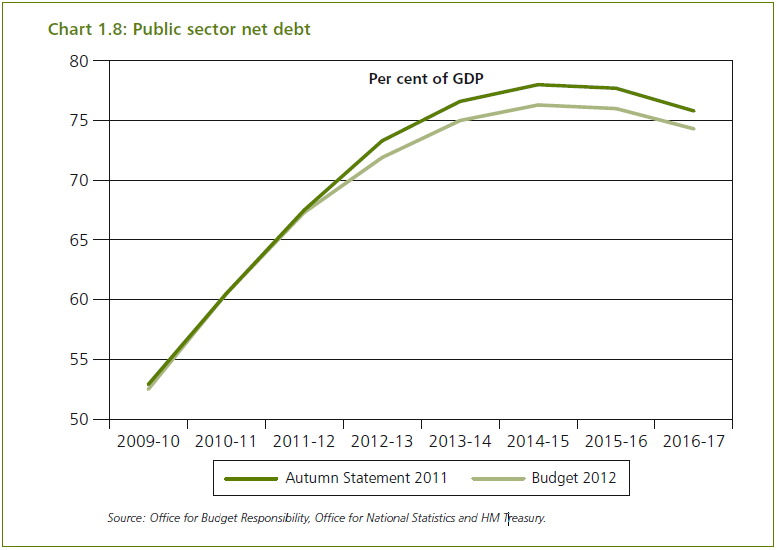
Via the Chancellor’s Autumn Statement (PDF), the revised trajectory of public sector net debt:

Click for Autumn Statement Green Book (PDF)

City AM reported back in July on a poll that,

asked whether the coalition would be keeping the national debt the same over the next four years, increasing it by £350bn or cutting it by £350bn. Just nine per cent got it right – 21 per cent thought it would be staying the same and an astonishing 70 per cent thought the national debt would be cut by £350bn.

Allister Heath went on to call this widespread failure to distinguish between debt and deficit “a massive failure of journalism”. I wonder what the survey would report today, now that the debt will be even larger.

The deficit is what the Government intend to reduce: that is, the shortfall between taxes and spending. Our debt will not just continue to balloon, but to ballon to a greater degree than forecast.

See also:

Today’s strike action is unjustified

The strike taking place today is not just a walkout, but a walking away from the negotiating table, where a good deal was rejected irresponsibly. The Minister for the Cabinet Office, Francis Maude, has said:

“Tomorrow’s strike is inappropriate, untimely and irresponsible, especially while talks are ongoing.

“We have listened to the concerns of public sector workers and that is why at the beginning of this month we put an improved offer on the table.  The offer ensures that public sector pensions will remain among the very best available while also being fair and affordable to taxpayers.

“While discussions are continuing I would urge public sector workers to look at the offer for themselves rather than listening to the rhetoric of their union leaders.  These are the sort of pensions that few in the private sector can enjoy.

The Government have made sure that anyone who is within ten years of retirement will be able to retire on their current terms and they have also confirmed that low earners making under £15,000 a year (15% of the workforce) will not have to make increased contributions. In addition, another million workers earning up to £21,000 will have their total increase limited to 1.5 per cent over three years.  Accrued benefits that people have built up already will be protected.

I find myself reflecting on the situation faced by those without taxpayer-guaranteed benefits. Suppose the aim is a retirement income of £15,000 a year for life. That means buying what’s known as an annuity. With pension savings of £10,000 buying an annuity worth about £500 a year today, to achieve just £15,000 a year, one would need pension savings of £300,000. To achieve a more comfortable £25,000, one would need to have saved £500,000.

And that income would not be index-linked for protection against inflation.

The TaxPayers’ Alliance has produced a Public / Private Pay Comparison calculator, which is illuminating. It’s a great pity that public and private sector workers have been set in conflict like this but low-risk, tax-funded pay and pensions should never have been allowed to outstrip those funded by riskier commercial activity. We have some wonderful, dedicated and talented workers in our schools, hospitals and elsewhere, and I regret that so many governments have misled them about their relative benefits.

The victims of today’s strikes will be the people who pay strikers’ wages and pensions – the everyday people of Britain. At a time when we are trying to get the economy back on its feet, when we face catastrophic public debts, a strike is the last thing anyone needs.

National Insurance Fund: No quick fix

This post is by Tim Hewish, my Parliamentary Assistant.

A number of Steve’s constituents have written to him regarding the National Insurance Fund (NIF).  The Fund was flagged in the media when it lost £4.5bn back in March which is the first time since 1993 that it had decreased. This was largely attributable to an increase in benefit payments and a reduction in National Insurance contributions.

The argument being advocated by a select number of pension lobby groups is that the NIF could pay for the loss in pension funding. Their rationale is because the Fund now stands at £48.5bn and remains significantly above the minimum working level recommended then this surplus can and should be used.

However, The NIF is intended to be the ‘current account’ of the National Insurance scheme, holding sufficient funds to even out fluctuations in the movement of contributions and to provide a source of finance to meet exceptional demands. These demands are meant to be used primarily for unemployment benefit and sickness benefit, although a smaller percentage has been used for retirement pensions.

In addition, the true scale of our public liabilities is estimated at a staggering £6.5trn or £105,177 for every man, woman and child in the UK. One only needs to look at the UK debt trajectory to grasp the unsustainable position that we find ourselves. A Bank for International Settlements working paper, The Future of Public Debt: Prospects and Implications, shows projections of public debt which lead them to conclude that the measures pursued by a number of developed countries are indefensible. Drastic measures are necessary to check the rapid growth of current and future liabilities.

Their findings suggest that unless fiscal policy changes, by 2020 the primary deficit/GDP ratio will rise by 8-10% in the UK and in the next decade the UK Government debt/GDP ratio rise would be 200%, while the fraction absorbed by interest payments would be as high as 27% in the UK.

Meanwhile, this Economist chart neatly shows that debt rose across the developed world during the boom, from consumers maxing out credit cards to financial firms taking on more leverage, and that the process of reducing it is still at a very early stage.

The UK’s own debt as a percentage of GDP is crippling: Government debt stands at 78%, Household Debt 100%, Financial debt 205%, and non-financial 115%. This is a total of 495% which is the highest of any nation in the world.

Quick fixes are not going to secure Britain’s economic future. That is why Steve has set up the All Party Parliamentary Group on Economics, Money and Banking that seeks to act as a hotbed of ideas on how to mend our broken socio-economic system.

Why Is There a Euro Crisis?

From a magnificent article by Philipp Bagus – Why Is There a Euro Crisis?

Today’s banks are not free-market institutions. They live in a symbiosis with governments that they are financing. The banks’ survival depends on privileges and government interventions. Such an intervention explains the unusual stock gains. On Wednesday night, an EU summit had limited the losses that European banks will take for financing the irresponsible Greek government to 50 percent. Moreover, the summit showed that the European political elite is willing to keep the game going and continue to bail out the government of Greece and other peripheral countries. Everyone who receives money from the Greek government benefits from the bailout: Greek public employees, pensioners, unemployed, subsidized sectors, Greek banks — but also French and German banks.

Europeans politicians want the euro to survive. For it to do so, they think that they have to rescue irresponsible governments with public money. Banks are the main creditors of such governments. Thus, bank stocks soared.

The spending mess goes in a circle. Banks have financed irresponsible governments such as that of Greece. Now the Greek government partially defaults. As a consequence, European governments rescue banks by bailing them out directly or by giving loans to the Greek government. Banks can then continue to finance governments (the loans to the Greek government and others). But who, in the end, is really paying for this whole mess? That is the end of our story. Let us begin with the origin that coincides with beneficiaries of the last EU summit: the banking system.

The vast majority of commentary — particularly this week’s extremely disappointing Economist magazine — crassly neglects the tight nexus between banks and the state which has funded politician’s unrealistic promises for a generation through currency debasement. It’s good to see Philipp Bagus — a German economist working in Spain — making a case which is sadly lacking elsewhere.

PAUL: One year to go – Washington Times

Via PAUL: One year to go – Washington Times (and twitterer @tomjdalton):

I firmly believe the American people are serious about cutting spending and fixing our debt crisis now. Those struggling to make ends meet and provide for their families while also trying to save for the future know we must change course immediately.

I’m not running for president merely to trim a little here and there from our bloated federal budget. Instead, I have offered the boldest, most specific and most comprehensive solutions in the history of American politics to restore our economy and once again make America the most innovative, competitive and prosperous nation in the world.

We face no problem that cannot be solved by reaffirming our trust in the fundamental principles of freedom, limited constitutional government and individual responsibility.

I recommend the rest of the article: for example, “I will move to abolish all corporate subsidies and end all bailouts.”

The question is not whether these are the right arguments, but how to win these arguments in the UK.

Discussing EU multilateral debt write-offs with Jeremy Vine

I was grateful to the BBC today for the opportunity to discuss my colleage Dr Anthony J Evans’ work for ESCP Europe on the potential for multi-lateral debt write offs between EU nations.

You can find the interview here at about 1 hour 10 minutes and Anthony’s work is here.

As I said in the interview, there are all kinds of catches and complexities but, as Anthony has said, multilateral debt write-offs between EU member states are a policy option.

More of Anthony’s economic work is available here, including the superb measure of the money supply he developed with Toby Baxendale.

Accessible and insightful fiscal analysis with Ray Stevens

American musician Ray Stevens has produced this superb analysis of the Obama Budget Plan:

I’m sure Ray has much to teach politicians and the public in the UK and Europe too, particularly about ethics and decency in the public finances.

For more on that subject, see Jörg Guido Hülsmann’s brilliant book The Ethics of Money Production (PDF) and these sovereign debt projections from the Bank for International Settlements.

Inflation and government borrowing

In his short article Inflation and You, Ludwig von Mises explains inflation itself, the social and economic effects of inflation, who inflation’s victims are, the futility of attempts to hedge against inflation, the moral and political effects of inflation and, finally, inflation and government borrowing. I thoroughly recommend the whole article, but I reproduce the section on government borrowing, which seems particularly pertinent at the moment:

Inflation and Government Borrowing

The writer, having witnessed the course of inflations in one European nation after another, believes that it is not too late to stop further inflation in the United States by bold and painful measures. Inflation is not an act of God. It is a result of the methods used to provide a part of the means for the conduct of the war. One set of methods can still be replaced by another, less harmful set. It is still possible to keep down the amount of money and money substitutes by financing the total amount necessary through taxation and loans.

People sometimes call inflation a special way of “taxing” a country’s citizens. This is a dangerous opinion. And it is wholly untrue. Inflation is not a method of taxation, but an alternative for taxation. When a government imposes taxes, it has full control. It can tax and distribute the burden any way it considers fair and desirable, allotting a larger share of the tax burden to those who are better able to carry it, reducing the burden on the less fortunate. But in the case of inflation, it sets in motion a mechanism that is beyond its control. It is not the government, but the operation of the price system, that decides how much this or that group will suffer.

And there is another important difference. All taxes collected flow into the vaults of the public treasury. But with inflation, the public treasury’s gain is less than what it costs the individual citizen, since a considerable part of that cost is drained off by the profiteers, the minority that benefits from the inflation.

It is no less fallacious to consider inflation as a method of raising loans for public use. Technically, inflation does increase the total of the government’s indebtedness to the banks. But the banks’ intervention is only instrumental. If the government borrows from the banks, the banks do not grant loans out of their own funds, or out of money deposited with them by the public; the banks are not real lenders; they grant the loans out of their “excess reserves.” They merely expand credit for the benefit of the government. In other words, they increase the quantity of money substitutes.

When you as an individual buy a government bond, you make a loan to the government; you put part of your cash holdings into the hands of the treasury. There is then no increase in the total quantity of currency or credits available and hence no inflation.

However, it is different when government borrows from the banks’ “excess reserves.” Their so-called “excess reserves” are not a tangible thing. The term is merely a phrase indicating the limits within which the law is prepared to tolerate credit expansion, that is to say further inflation. The effects of loans from available “excess reserves” are just as inflationary as the effects of issuing more paper money. It is a mistake, therefore, to confuse this government “borrowing” from the “excess reserves” of the banks with genuine loans.

Popular education is absolutely essential. It is clear that the efforts of the U.S. government to collect the means necessary for the conduct of the war by taxation and by sale of government bonds represent sound measures for heading off inflation. Everybody should be made to understand that the burden of high taxes and of making personal loans to the government are minor evils compared to the disastrous and inexorable consequences of inflation. Not only for the sake of the national welfare, but for the sake of your own interests–whether you are rich or poor, employer or wage earner–you should do your best to arrest the further progress of inflation.

See also Hülsmann, The Ethics of Money Production for a detailed explanation of how the production of money has become an instrument of exploitation and the consequences.

Spending – up. Borrowing – up. Debt interest – up.

Via National Statistics Online – Public Sector Finances, the trajectory of cumulative public borrowing this year more or less matches last year:

Public borrowing and net debt

See also Deficit plan under pressure as UK borrows £14bn more in June.

Here’s the tragedy: while my constituents and people across the country are seeing real reductions in services and worrying about cuts to public spending, public sector borrowing in June was slightly worse than last year and Government expenditure will increase in cash terms every year of the next five.

In that context, press coverage of our dreadful financial position is woeful.

The state continues to live beyond its means, even as this Government wrestles to bring spending under control. Our public debt is increasing. The Bank of England continues to hold down the headline rate of interest. Inflation is too high, with all the injustice that entails for savers and those on low or fixed incomes.

Prosperity does not follow from borrowing to fund present consumption: it comes from consuming less than is produced, saving the excess and investing in capital goods, real productive capacity. If we are serious about prosperity for everyone in this country, journalists must raise the quality of public debate and Government spending must be reined in with the consent of the population.

That is the task facing the press today: not to promote denial or despair, but to encourage real understanding of the scale of the challenge we face.