On trial by jury


Via The Last Ditch: Another step toward the abyss:

I despair. The right to trial by jury has protected Englishmen from an over-mighty state since long before democracy was born. Combined with the Great Writ of habeas corpus, it meant you could not be detained without trial and that your trial must be by 12 independent jurors. For most of the last 400 years, those jurors were required to decide unanimously that you were guilty. If they couldn’t, you were acquitted. The odds were loaded against the state and in favour of the citizen. Guilty men went free, that’s true. But (though nothing human is perfect) the odds of an innocent man being convicted were reassuringly small.

In the last century, in the wake of jury-nobbling scandals, majority verdicts were introduced. Even then, some thought that the state should do more to protect jurors, rather than implicitly accept that criminals could intimidate them. The efficiency of the justice system was put before the ancient rights of free Englishmen. Those who saw it as “a slippery slope” were dismissed as old fashioned.

Read on.

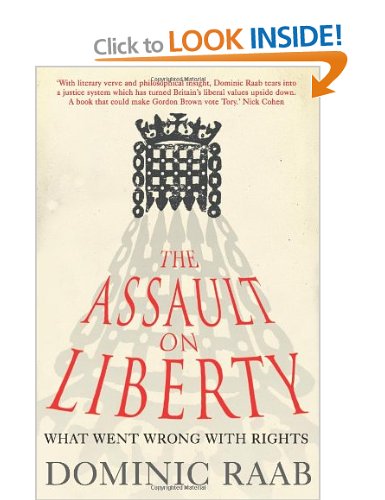
I support the restoration of the absolute right to trial by jury and I am delighted that Dominic Raab, author of The Assault on Liberty,  is also a Conservative PPC.

A serious breach of etiquette

A serious breach of etiquette from The Prisoner:

In your heads must still be the remnant of a brain! In your hearts must still be the desire to be a human being again!

Shocking. I think I will just go and watch it to make sure.

Further reading

And the stats go through the roof…

Flatteringly, today, one or more people have arrived directly and explored well over a hundred pages in a single day.

stats1

Interesting, and eery.

Road pricing killed off by Transport Secretary, Lord Adonis – Telegraph

Plans to impose pay as you drive charges on every motorist in the country have been killed off by Lord Adonis, the new Transport Secretary.

The proposals, which would have seen drivers paying up to £1.30 a mile during the rush hour, will not now be included in the next Labour manifesto.

His decision represents a major volte face by the Government which had once regarded national road pricing as a flagship policy.

via Road pricing killed off by Transport Secretary, Lord Adonis – Telegraph.

Britain leads world in police state survey | The Register

cryptohippieVia Britain leads world in police state survey • The Register:

A recent survey from internet security consultancy, Cryptohippie, suggests that the UK is setting the pace in at least one area – though being classified as the West’s most repressive regime when it comes to electronic surveillance might not be a title that this government is entirely happy to wear.

This result emerges from Cryptohippie’s recently published Electronic Police State 2008 (pdf). This is the first in what are intended to be a series of annual reports that will audit the “State use of electronic technologies to record, organize, search and distribute forensic evidence against its citizens”.

The audit focusses on 17 factors, ranging from requirement to produce documents on demand, through to the extent to which states force ISP’s and phone companies to retain data, the blurring of boundaries between police and intelligence work and ultimately the breakdown of the principles of habeas corpus.

The panopticon makes progress

Via BBC NEWS | Technology | Net firms start storing user data:

Details of user e-mails and net phone calls will be stored by internet service providers (ISPs) from Monday under an EU directive.

Feel safer?

The Great Deception

A good time to complete Booker and North’s extensive history of the European Union — “The Great Deception – Can the European Union survive?” — seemed to be these last few weeks, as I visited Portugal, France, Germany and Austria. It was an enlightening read.

I have visited most countries in western and northern Europe, perhaps all except Finland, Eire and the Balkans. I have also worked and toured widely in North America, the Middle East and Asia: those trips were a great pleasure but Europe is home and I love it. The political structure that is the European Union is another matter.

There runs through human history the idea that mankind could be happy, if only the good and wise were allowed to rule the rest, free of the inconvenience of democratic accountability. The European Union is yet one more embodiment of this idea.
Read more

Britain now the most invasive surveillance state

Via Right to privacy broken by a quarter of UK’s public databases, says report | The Guardian, we learn that “Britain is now the most invasive surveillance state and the worst at protecting privacy of any western democracy”:

A quarter of all the largest public-sector database projects, including the ID cards register, are fundamentally flawed and clearly breach European data protection and rights laws, according to a report published today.

Claiming to be the most comprehensive map so far of Britain’s “database state”, the report says that 11 of the 46 biggest schemes, including the national DNA database and the Contactpoint index of all children in England, should be given a “red light” and immediately scrapped or redesigned.

The full report is available here. It uses somewhat stronger language:

Of the 46 databases assessed in this report only six are given the green light. That is, only six are found to have a proper legal basis for any privacy intrusions and are proportionate and necessary in a democratic society.

After working around government as a software consultant for several years, I particularly endorse this recommendation:

There should never again be a government IT project – merely projects for business change that may be supported by IT. Computer companies must never again drive policy.

Examining the arguments for the ID Card scheme and the National Identity Register provides a case in point.

ID Cards Fiction and FactLiberty Human Rights maintain a short leaflet, “ID Cards, Fiction and Fact” which explains:

  • The ID Card and National Identity Register schemes will cost us privacy and cash.
  • The government’s claims about the benefits of the program are fiction.
  • ID Cards will not protect us from terrorism.
  • ID Cards will not cut crime.
  • ID Cards will increase discrimination.
  • The Government will not keep our data private.
  • The scheme is expensive and of no use.

You can join Liberty here.

The Conservatives go further in their criticism of the scheme here, pledging to abolish it. You can join the Conservatives here.

Government abandons data-sharing scheme – Telegraph

The Government has been forced into an embarrassing U-turn over plans to share vast amounts of private data about individuals.

Jack Straw, the Justice Secretary, is to shelve proposals which critics said would have led to patients’ confidential medical records being passed to third parties.

A spokesman for Mr Straw said the “strength of feeling” against the plans had persuaded him to rethink.

The proposals will be dropped entirely from the Coroners and Justice Bill, and a new attempt will be made to reach a consensus on introducing a scaled-back version at an unspecified stage in the future.

via Government abandons data-sharing scheme – Telegraph, but watch the back door…

Road speed limit cut to 50mph

THE government is to cut the national speed limit from 60mph to 50mph on most of Britain’s roads, enforced by a new generation of average speed cameras.

The reduction , to be imposed as early as next year, will affect two thirds of the country’s road network. Drivers will still be able to reach 70mph on motorways and dual carriageways and 60mph on the safest A roads.

via Road speed limit cut to 50mph . But the safest speed for a road is the 85th percentile. More to follow…

Revealed: police databank on thousands of protesters

Police are targeting thousands of political campaigners in surveillance operations and storing their details on a database for at least seven years, an investigation by the Guardian can reveal.

Photographs, names and video footage of people attending protests are routinely obtained by surveillance units and stored on an “intelligence system”. The Metropolitan police, which has pioneered surveillance at demonstrations and advises other forces on the tactic, stores details of protesters on Crimint, the general database used daily by all police staff to catalogue criminal intelligence. It lists campaigners by name, allowing police to search which demonstrations or political meetings individuals have attended.

via Revealed: police databank on thousands of protesters | UK news | guardian.co.uk .

BBC NEWS | Politics | ID card ‘flash and dash’ warning

Toby Stevens, of the Enterprise Privacy Group, believes a shortage of fingerprint scanners could lead to an explosion in “flash and dash” fraud.

And that, he says, could scupper the scheme before it gets off the ground.

The Home Office has said it will set up a hotline for traders concerned about the authenticity of ID cards.

via BBC NEWS | Politics | ID card ‘flash and dash’ warning.

The Economist’s attitude to liberty today

A mob of Britain’s finest eccentrics will gather in central London on February 28th. Their ranks will include outspoken novelists, radical lawyers and fed-up judges. David Davis, an unusual MP who left the shadow cabinet to wage guerrilla war from the backbenches, will be there; so will Shami Chakrabarti, the relentless head of Liberty, a pressure group. Several of those attending can sometimes seem pious; but in a stubborn, deeply English way, many are rather magnificent. The occasion is the “convention on modern liberty”, an event designed to rally opposition to the ongoing erosion of rights and freedoms in Britain (there will be similar meetings in other cities).

via Civil liberties during a recession | The price of freedom | The Economist. The word “eccentric” appears four times in the article.

Convention on Modern Liberty: “What we have lost”

From the Convention’s “Abolition of Freedom Act 2009″:

One of the problems with the erosion of liberty in Britain over the last decade was that the public failed to pay attention to what was happening in Parliament. Laws that fundamentally challenged our traditions of rights and liberty and flew in the face of the Human Rights Act (“HRA”) were passed with relatively little debate. Few grasped the impact they would have on our society and Ministers were able to brush aside protests with assurances that their desire to protect us was equal to their respect for civil liberties.

The difficulty campaigners faced was to press home the argument about the scale of the loss. An account was needed to show that the legislative programme, which swept away centuries old rights and transferred so much power from the individual to the state, actually existed. Now we have that evidence and the Convention on Modern Liberty can demonstrate with confidence what Britain has lost and discuss how this crisis of liberty took root in one of the world’s oldest democracies and what to do about it.

David Davis is contributing to the campaign, asking, “When was the last time liberty collapsed in Europe?”:

And from The Guardian (and others) today:

The government has admitted that British troops in Iraq handed over terror suspects to the US, which then secretly rendered them to a prison in Afghanistan.

After a year of allegations and repeated ministerial assurances to the contrary, the admission was made in the Commons by John Hutton, the defence secretary, who apologised to MPs for inaccurate information ministers had previously given them.

Please read the report and talk about it. Please let people know what they have lost and encourage them to write to their MP.

Fight against terror ’spells end of privacy’

How I look forward to The Convention on Modern Liberty:

Sir David Omand, the former Whitehall security and intelligence co-ordinator, sets out a blueprint for the way the state will mine data – including travel information, phone records and emails – held by public and private bodies and admits: “Finding out other people’s secrets is going to involve breaking everyday moral rules.”

via Fight against terror ’spells end of privacy’ | UK news | The Guardian .

Sir David’s IPPR paper is here.

Modern Liberty

Via Spy chief: We risk a police state – Telegraph:

Dame Stella [Rimington, ex-head of MI5,] accused ministers of interfering with people’s privacy and playing straight into the hands of terrorists.

“Since I have retired I feel more at liberty to be against certain decisions of the Government, especially the attempt to pass laws which interfere with people’s privacy,” Dame Stella said in an interview with a Spanish newspaper.

“It would be better that the Government recognised that there are risks, rather than frightening people in order to be able to pass laws which restrict civil liberties, precisely one of the objects of terrorism: that we live in fear and under a police state,” she said.

Dame Stella, 73, added: “The US has gone too far with Guantánamo and the tortures. MI5 does not do that. Furthermore it has achieved the opposite effect: there are more and more suicide terrorists finding a greater justification.” She said the British secret services were “no angels” but insisted they did not kill people.

And:

In a further blow to ministers, an international study by lawyers and judges accused countries such as Britain and America of “actively undermining” the law through the measures they have introduced to counter terrorism.

Via Henry Porter: Calling the police to account | Comment is free | guardian.co.uk :

Although I write as someone who has no particular axe to grind about the police, I am beginning to wonder whether we have a serious problem with a police force that believes it is entitled to monitor political activity. Set against the new law banning photographs of the police – which surely will be used by every policeman parked on a double yellow line or meting out the rough justice – there is increasing tendency of the police to photograph people in an aggressive fashion. It shows an innate lack of respect for the innocent citizen and the conventions of our free society, which is extremely disturbing.

Via Marc Vallée: Under the Counter Terrorism Act 2008, documenting dissent is under attack | Comment is free | guardian.co.uk :

Terror legislation has been increasingly used by this government, and sometimes brutally enforced by the police, to criminalise not only those who protest but also those who dare to give the oxygen of publicity to such dissent.

From Monday it will be an offence to elicit or attempt to elicit information about an individual who is or has been a member of the armed forces, intelligence services, or a police officer in Great Britain – it’s been an offence in Northern Ireland since 2000. It will also be an offence to publish such information.

Via Police chiefs body faces calls for review after cash revelations | Politics | The Guardian :

The Association of Chief Police Officers was yesterday facing calls for a “fundamental review” of the way it works, after reports emerged that the independent organisation is raising millions of pounds through commercial activities.

Acpo, which advises the government on national policing policy and describes itself as “the voice of the police service”, was made a limited company in 1997, but has received £32m from the Home Office over the last two years.

I will be attending The Convention on Modern Liberty in London. Speakers include Douglas Carswell MPShami ChakrabartiNick Clegg MPDavid Davis MPAndrew Dismore MPEdward Garnier QC MPDominic Grieve QC MP and Lord Goldsmith.

If you think the debate is insufficiently measured, I suggest watching this:

There may be a regional convention in your area: check here.

Newspeak 2009

The Centre for Policy Studies has released The 2009 Lexicon, A guide to contemporary Newspeak

Some random examples:

Dialogue (meaningful): the pretence of genuine two-way conversation.

Equality: sameness. Absence of diversity.

Joined-up government: excuse for cross-departmental initiatives which will centralise and increase government intrusion into everyday life.

Radical (of reform): minor technical/organisational adjustment.

And so on.

It is recommended reading and yet, rather like the cartoon Dilbert, overdoing it might be unwise.

Some Costs of the Great War: Nationalizing Private Life

Following comments on the immediate astronomical human cost of the Great War:

Yet this essay has to do less with numbers of ended lives than it has to do with altered lives, or rather, with changes in the status of the private life of the modern individual, the modern family, the modern community. This essay is about private property, about the autonomy of the individual, and the disastrous trend, accelerated by World War I, of the state claiming the right to take at whim everything within its territory.

A secondary theme is that this great change in private life was already in process before 1914. The real agent of change was not the war, but the state and its backers and minions. Yet war as an accelerator of change was bad enough. Political and intellectual leaders in all countries welcomed the war for the collectivist changes it would inevitably bring. In the United States, one of the more important figures welcoming the war was John Dewey, a veritable god in the pantheon of our modern civil religion. Dewey saw the war, rightly, as the accelerator of the coming industrial society—a managed positivist society, which he thought of as democracy itself.

via Some Costs of the Great War: Nationalizing Private Life – T. Hunt Tooley – Mises Institute .

BBC NEWS | UK | Government plans travel database

The government is compiling a database to track and store the international travel records of millions of Britons.

Computerised records of all 250 million journeys made by individuals in and out of the UK each year will be kept for up to 10 years.

The government says the database is essential in the fight against crime, illegal immigration and terrorism.

via BBC NEWS | UK | Government plans travel database.

House of Lords: rise of CCTV is threat to freedom

The steady expansion of the “surveillance society” risks undermining fundamental freedoms including the right to privacy, according to a House of Lords report published today.

The peers say Britain has constructed one of the most extensive and technologically advanced surveillance systems in the world in the name of combating terrorism and crime and improving administrative efficiency.

via House of Lords: rise of CCTV is threat to freedom | UK news | The Guardian. Also:

The House of Lords report on Britain’s surveillance society is a devastating analysis of the systems that have been installed by the authoritarian Labour government and the controlling forces emerging in local government. There is no question now that Britain’s free society is under threat, and it is time for the public and opposition parties to declare an end to this regime of intrusion.

via Henry Porter: Reaction to the House of Lords report on surveillance society | Comment is free | guardian.co.uk .